Tactic 16. Price on Value
An emerging IXP can take advantage of the natural tendency for ISPs to buy only if the value exceeds the costs. An emerging IXP can’t charge the same fees as a dominant IXP without providing a corresponding value. All things considered equal, the ISPs will simply choose the IXP with the higher surplus peering value.
The value-based pricing tactic is to charge a monthly fee that is proportional to the benefit derived from participation at the time the contract is signed. This tactic commonly takes one of two forms.
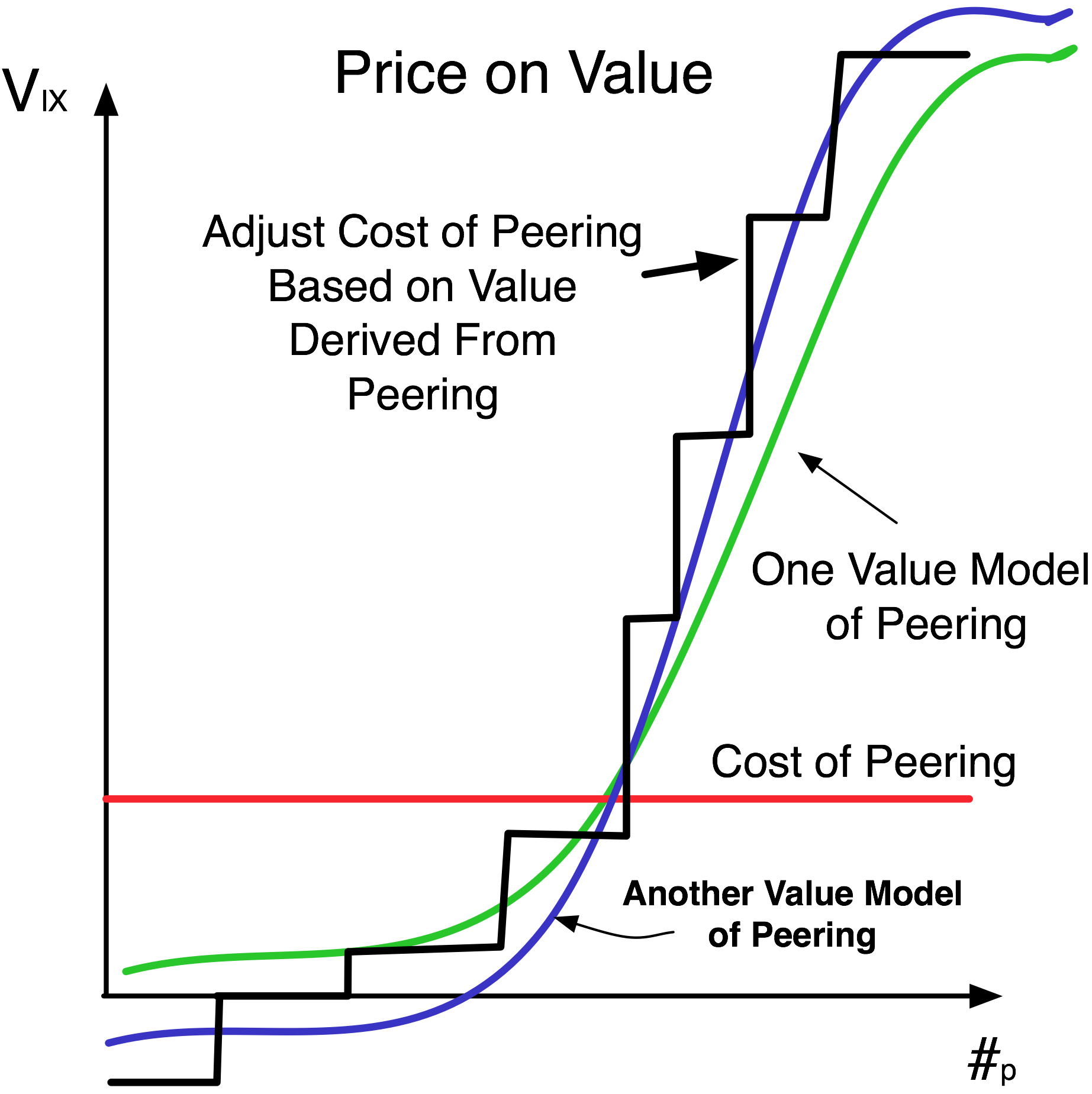
For the low end of the market, the IXP can sell partial-capacity peering ports at a lower cost, helping the low end of the peering market enter the IXP. As the number of connected ISPs increases, the credibility of the IXP increases and the population incrementally derives greater value. As the value of the IXP increases, the price of the peering ports can increase, as shown in Figure 13-12.
Value of the IXP = f(p, r, v, m) - c
p: The population
r: The routes available
v: The volume of traffic exchanged
m: The market perception of the IXP
c: The cost of participatioon at the IXP
A second approach is to price the ports on the switch based on the number of ISPs attached. The first ten ports would be heavily discounted (say 60% off retail price), the next ten less discounted (maybe 40% off retail price), and the next ten priced at just below market rates (say 20%). Once the “Critical Mass Point” is reached (where the cost of participation is justified), contracts can be adjusted upwards to market rates.
Ultimately these methods set the price proportionally to the value derived by the customers and help speed the growth of the peering population. Note that these price points may initially be negative, similar to Tactic 4, buying in those first few players as shown in Figure 13-12.