Chapter 12 – Taxonomy of Data Centers
In this chapter we will build a model of an Internet Exchange based on the top of a model of an Internet Data Center. All Internet Data Centers (IDCs) are made up of similar data center components. All data centers built to house telecommunications gear have some form of:
- real estate to house the gear
- security infrastructure to prevent unauthorized access to the equipment
- reliable power infrastructure to make sure the gear continues to operate even when utility power fails
- Heating, Venting, and Air Conditioning (HVAC) systems to keep the equipment within its operating range
- data center operations staff to monitor and manage the operations environment in the data center
We present the key differentiators across the data center and colocation business models (Figure 12-1), and finish with a discussion of the differences between European- and U.S.-based IXPs.


The Basic Data Center Model
Every data center has at least the following four components: real estate, some form of security system, reliable power infrastructure, and air conditioning systems as modeled in Figure 12-2.

Now we will discuss each of these components.
Real Estate
At the core of every data center is real estate, which is, as the expression goes, all about location.

However, for real estate destined to be a networked data center, proximity to fiber is critical, as fiber is what the tenants will ride in on (Figure 12-3). If the colocation center is far from fiber, then the cost of building in is higher. The most desirable real estate is located near fiber nexus points.


Some Real Estate Selection Criteria
Selection of location is absolutely critical for Internet Data Centers since it has a direct impact on the cost of the facility and the ultimate cost of participation. Here are a few of the selection criteria that colocation providers shared as key to their location search:
1. Fiber. Ideal sites will be near or on fiber paths, or within a couple miles of dark fiber and telephone company Points of Presences (POPs).
Fiber entrance facilities run the gamut from tying fiber to the wall of an alley, as shown in Figure 12-4, to cement-encased fiber entrances, as shown in Figures 12-5 and 12-6.


2. Size, floor loading, configuration, expandability. Sites must be large enough to support the intended operations, with floor loading sufficient for the equipment expected.

Shared Internet Data Center operators must prepare for random customer equipment, while a single customer (enterprise) data center may know in advance what types of equipment will be placed in the space.

There are many other issues regarding fitness for purpose, including weather (earthquakes, hurricanes, floods, etc.), proximity to hospitals, etc. Why proximity to hospitals? If a national disaster occurs, the hospital power grids will be repaired most quickly, so being near a hospital means your data center utility power feed also comes back up from a national disaster more quickly.

Large data centers are often constructed outside of major metropolitan areas. For example, the Docklands in the U.K. has several large-scale data centers (Figure 12-7) that house some of the largest network providers on the continent.

3. Utility power availability and price. Dual grid feeds are desirable, but the requirement for 3,000 amps at 480 volts per 50,000 are typically required for operations. Around 2008, power availability and unit price became critical selection criteria.
4. Facilities yard. There is often a requirement for space at ground level or on the roof for fuel tank(s), generators, chillers, etc. Space required varies, but generally at least 5200 square feet for the first 50,000 square feet of facility is needed. Even when some wholesale data center providers provide reliable power (such as Telehouse shown in Figure 12-7), some customers prefer to own and maintain their own Uninterruptable Power Supply (UPS) in their own private cage.

5. Local government support. Local, state, and federal governments often provide incentives for data center construction in distressed areas. Examples include tax abatements, ease of permitting, expedited access to rights-of-way, power, and support for fiber access that might otherwise require more extensive government, corporate, and community interactions. In some cases, discussion of the number of parking spaces, off-ramp development, signage, etc. are uncovered only at a very late stage of real estate selection.
A perfect example is Terremark’s Technology of the Americas Building in Miami, Florida. The company constructed a six-floor building in a “Federal Empowerment Zone” in downtown Miami, and along with other government programs, received several million dollars in support.
Equinix received similar support for the original Ashburn, Virginia, facility when it was still a corn field. Today Ashburn, Virginia, is known as a telecommunications hub for the U.S.

6. Location of customers and support staff. Since these data centers will ultimately be used by customers and support engineers, it is important that local talent be available. Building a data center in the middle of nowhere would make it difficult to attract and retain people to support the equipment and infrastructure in such a building.
7. Cost of real estate. The location of the IDC to a large degree dictates the cost of the IDC.
Sean Donelan made an important point about the cost of a bad choice of real estate:
“You can save a lot of money choosing the right site, but you can spend a lot of money on the site trying to upgrade it to the appropriate standards. Many of the most expensive problems to fix at the end of the build are due to the selection of Real Estate at the beginning of the build.”
Many criteria must be evaluated with respect to suitability of real estate. For example, all others things being equal, if there is sufficient lead time, many prefer a “greenfield” (brand new) building over an existing building. Time-to-market issues may dictate retrofitting existing facilities (to meet seismic standards, appropriate bracing for floor loading, drainage systems, etc.). Sometimes, demolition and retrofitting can save valuable time to market.
Hidden charges and unexpected delays affect deployment. For example, some telco hotels require interconnection of its tenants via risers to “meet-me” rooms. Some fiber providers have complained that every splice of fiber causes signal loss and meet-me rooms lead to another splice. Further, the expense of running a cross-connect within a building and the time to delivery are not always known.
When considering the buy decision it is important to ensure sufficient space is available for expansion and sufficient time remains on the IDC lease.
Among the core systems, real estate cost is the most variable and may have the largest overall impact on the cost of the facility.
8. Large data centers. According to Roy Earle, for shared colocation facilities there is a trend away from the smaller traditional telco hotel sizes (typically 20,000 sq ft) towards the warehouse-sized facilities (on the order of 300,000 sq ft). While this model allows scaling of infrastructure, it also dramatically reduces the choice for sites. The data center build choice doesn’t suffer from this ailment since smaller amounts of space are easier to find. This effect is compounded by the fact that large warehouses suitable for data centers are typically outside of the major metropolitan areas and therefore likely far away from telco and fiber provider Points of Presence (POPs).
Fire suppression is included in the real estate model as many buildings require sprinkler systems and/or other fire-suppression technologies (dual-trigger activated sprinklers, FM-200, etc.) regardless of the application of the building.
Some large IDC operators interviewed have real estate teams that rate possible locations by hundreds of metrics; they consider these selection-criteria documents to be highly proprietary – their real estate team “secret sauce.”
Security Systems
Security includes all systems protecting the physical assets in the Internet Data Center: perimeter and in-building access control and monitoring systems as well as security guards, escorts, and physical add-ons like bulletproof glass and Kevlar perimeter walls.
If the data center will service a single tenant, then the security systems ring can be as simple as a badge-secured exterior and a sufficiently secured employee badge reader (Figure 12-8). For multi-tenant data centers, however, the security ring gets more complicated.

Shared Internet Data Center security systems must handle the added complexity of access of multiple customers. Solutions range from escorted access and supervised use to free (zoned) access. This complexity may not be required if the data center is built solely for use by a single company. In both cases, the goal is to keep unauthorized staff away from the colocated equipment.

The cost and scaling of the security depends more upon the application than on the scale of the data center. For example, a small section of a building that is essential to the operation (like the cashier office in a casino) may be equipped with armed guards, many surveillance cameras, etc. Likewise a shared facility may require more participant cages and authentication than a single-user facility.


Having said all of that, economies of scale do exist. The incremental cost is small. Additionally, the larger facilities can allocate the indirect costs of guard access gates (Figure 12-9), circulating guards, bulletproof glass, and Kevlar perimeter protection, etc. across a larger set of equipment, helping make the actual unit cost for security of large data centers lower on a per-rack basis.

It was pointed out that customers tend to demand more security from a shared facility than they would from their own facility because many believe that collectively they can afford more than they can individually. For example, integrated environmental (temperature, humidity, electric draw) and security (surveillance cameras on both sides of racks, cage access log) information feeds may be “required” since the cost per rack is relatively low. Shared environments generally require more complex security systems.
One practical implication of security in a shared data center is physical access. When equipment must be repaired during off hours, some Internet Data Centers (particularly telephone company facilities) do not make it easy to gain access to the failed equipment in the middle of the night. Others require escorts at all times.

After the real estate is fitted with a security system, it is secured and inherently more valuable than plain real estate. Next we will increase the value by adding conditioned power and air to the model.
Power Systems
With the addition of the Power Systems ring in the data center, the real estate is more valuable (Figure 12-10). It isn’t just square feet with fire suppression and location – it also has conditioned power, and can independently provide power during disruptions of the electrical feeds into the building (brownouts, blackouts, power spikes, etc.).


For some customers, the availability and price of power were key selection criteria when selecting between colocation companies.
HVAC Systems
Next we add to the powered data center a Heating, Venting, and Air Conditioning (HVAC) system. Now the facility has fully conditioned space and power suitable for reliably hosting telecom equipment (Figure 12-11). This property now is much more valuable than plain real estate.

HVAC systems are critical for maintaining an operations environment for networking and computing equipment. According to IBM, computing machinery operates best between 18° C (65° F) and 29° C (85° F) with humidity between 20% and 62% relative humidity. Too much humidity can cause system failure, while too little humidity generates static electricity. IBM recommends an optimal temperature of 24° C (76° F) and 45% relative humidity.
HVAC infrastructure provides this conditioning. HVAC systems also benefit from economies of scale. Large-scale IDCs can utilize high-efficiency (and high-cost) HVAC systems and share the costs across a potentially large number of customers. These larger systems have the added benefits of requiring fewer units to perform the same task, resulting in higher Mean Time Between Failures and lower Mean Time To Repair.


Data Center Operations
This infrastructure requires data center operations staff.


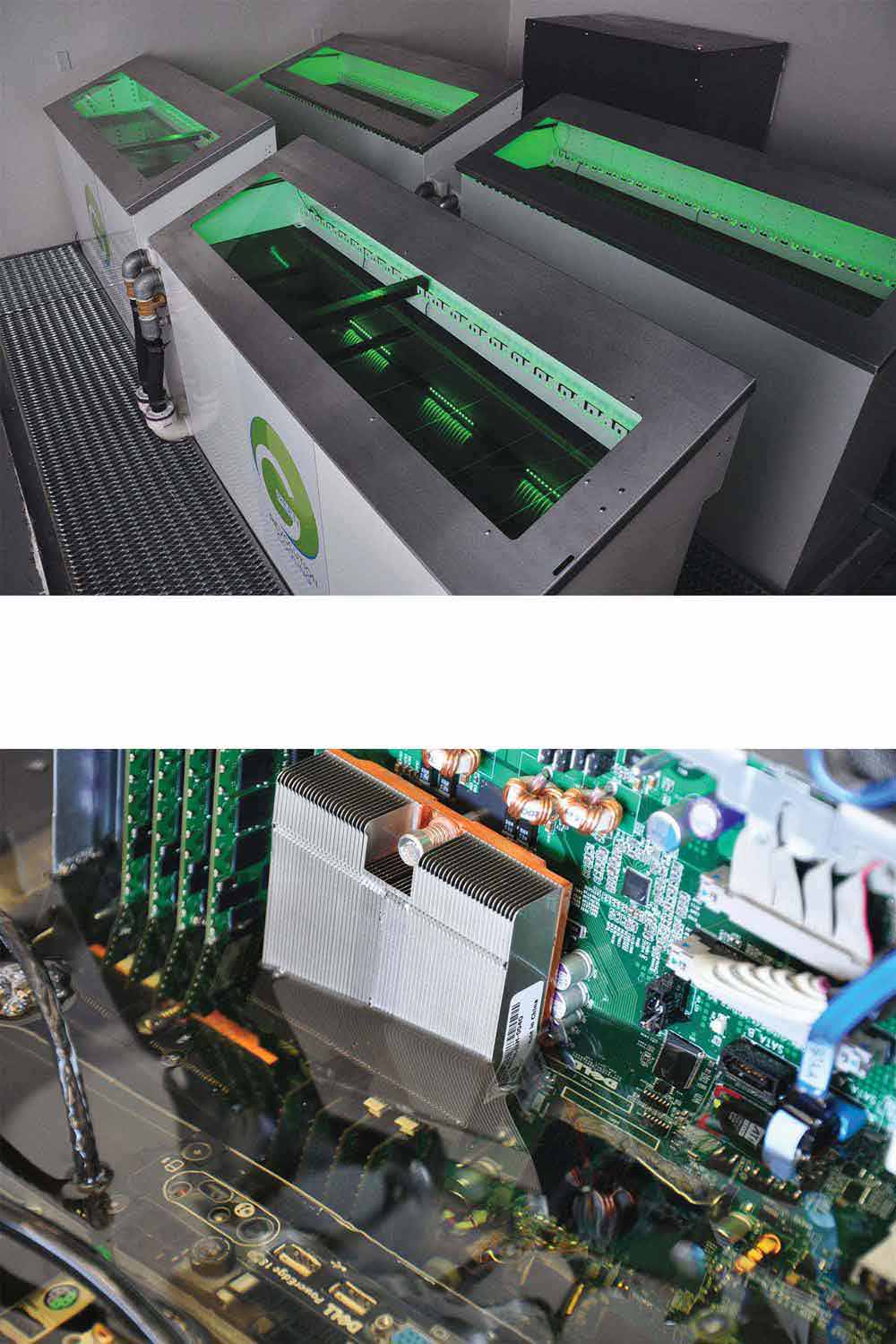

Perhaps most importantly, when things break, and they will, how will the IDC handle the situation and how will it communicate with its customers?

As valuable as a data center is at this stage of development, with no way in or out, it is an island, so we will next add network to the data center.
The Networked Data Center
Data Centers can be operated by several different types of players, including carriers, ISPs, providers of colocation services, and completely neutral entities. This section will help you understand some of the differences between them, particularly with respect to the U.S. vs. European IXP models.
Carrier Data Center
As stated before, without a network, a data center is an island. If a carrier owns the data center, we call it either a:
- Carrier Point-of-Presence (POP) or
- Carrier colocation space
The carrier ring in the model (Figure 12-13) demonstrates the ability for multiple competing carriers to offer connectivity within a building.

Definition: Carriers are layer 2 transport providers.
When we say carriers, we are referring to the folks that bring in layer 1 and layer 2 – dark fiber, lit fiber services, and circuits for the tenants to use to get bits into and out of the data center.
Most carrier data centers do not allow competitive providers to sell transport to their customers in their space. Some companies have referred to carrier data centers as “telco jails” since they can’t get their content out of the building unless the carrier data center owner sells them transport services.
The Carrier Point-of-Presence (POP)
Definition: Carrier POP is space within a carrier data center that is operated solely for the use of the carrier itself.
A Carrier POP is a relatively small footprint in a data center. This space is a data center space with only one customer – the carrier itself.
The Carrier Hosting Facility
Definition: Carrier Hosting Facility is space within a carrier data center that is purpose-built for the use of hosting the carrier and its customers.
Carriers may also lease data center space from others and use it for a POP or hosting space.
Carrier-Neutral Data Center
Definition: Carrier-Neutral Data Center is a data center that is neither owned nor operated by a company that offers carrier services.
A Carrier-Neutral Data Center does not compete with its carriers for transport (circuits) and, therefore, carriers generally do not have a disincentive to build in and support this business model. The Carrier-Neutral Data Center brings in multiple carriers for the customers to choose from, creating an open market for transport services in the building.
What happens when a carrier acquires a Carrier-Neutral Colocation company?

Internet Data Center
Definition: Internet Data Center is a data center with Internet access.
ISP Data Center
An ISP Data Center is an Internet Data Center that is owned by an ISP. It has one or more carriers providing transport into the building, but being owned by an ISP, generally allows its customers to access only its own Internet Transit services. There is no open market for Internet Transit services here (Figure 12-15).

Internet Service Provider POP
Definition: ISP POP is space within a data center operated by an ISP that is solely for the use of the ISP itself.
An Internet Service Provider POP is where you will find routers, out-of-band access equipment, tributary routers, etc. that support the operation of the ISP network. An ISP POP supports exactly one customer – the ISP itself. If it supports more than itself, it would be categorized as an ISP Hosting Facility.
An ISP Hosting Facility
Definition: ISP Hosting Facility is space within a data center that is operated by an ISP providing conditioned space and power along with Internet Transit services for its customers.
An ISP Hosting Facility is where you will find space for colocated customers (shown as lines across the outer ring in the model shown in Figure 12-15). There is typically only the ISP providing Internet Transit services to the population, so we show that as a solid, single ring.
An ISP and Carrier-Neutral Internet Data Center
Definition: ISP and Carrier-Neutral Internet Data Center is a data center that is operated by an entity that neither competes with nor offers transport or Internet Transit services that compete with the carriers or ISPs.
As a result of this neutrality, the ISP and Carrier-Neutral Internet Data Center is modeled as shown in Figure 12-16, with multiple carriers (shown as the ring with lines separating the various carriers) and multiple ISPs (shown as the outermost ring with lines separating the various ISPs) providing an open market for transport and Internet Transit services.

Notes from the field.
The inherent value of this facility is proportional to the number, diversity, and desirability of the wide range of transport and transit services, along with the capability to peer with each other.
Another key value of the carrier-neutral IDC is the open market for Internet Transit services. The ISPs can participate in the marketplace for transit services without any market distortions. Here again, an ISP-owned data center is unlikely to have competitors in its building selling transit to its customers, but a colocation center will tend to have a variety of ISPs forming the open marketplace for transit services. Some in the community have estimated that prices for transit could be 30% less in well-populated colocation centers. The robust marketplace for transit and peering are the key value propositions that will bring additional customers in.
IDCs for Hosting Content
The outermost ring of the data center model is for content companies that take advantage of the network. Here we have the hosting companies, portals, CDNs, Content Providers, etc. These participants tend to prefer a richly networked IDC with an open marketplace of ISP services, providing the required flexibility, robustness, and ever-decreasing transit prices.

Colocation vs. Wholesale IDC
Some data centers are carrier-neutral and ISP-neutral, but are built with the primary intent of reselling or leasing large chunks of that space to others on a wholesale basis. This model is different from the colocation companies that focus on building the “right” population that maximizes the interaction value to its customers.
-provide-heat-rejection-while-2N-breaker-boards-(grey%2c-center)-provide-power-to-N%2b2-PDUs-(grey%2c-right)_fmt.jpeg)

One way to differentiate these two categories is with the litmus test – does the operator actively evangelize interconnection among a large population of participants? If the answer is yes, then we have a colocation company. If the answer is no, then we have a wholesale data center (Figure 12-17).

The key differentiator between providers of real estate and providers of colocation space is the managed ecosystem. Colocation is more than a real estate play – successful colocation providers understand their customers’ ecosystem, and build the right mix of players based on how customers interact with and derive value from each other.
A common question follows:
“Given enough money, can a competitor reproduce what a well-populated colocation provider has?”
It is possible, but very difficult because the value of the IXP is proportional to the number and diversity of the population there. Since these players are already in the building and presumably getting value from the presence, it will be difficult to get them to move or build in to obtain the same value. The population is a long-term sustainable differentiator for well-populated colocation centers. It is interesting that the main value of the colocation center has nothing to do with the physical data center (which can be reproduced) but has everything to do with the population.
Colocation Providers
There are generally two models for colocation providers – those that also operate a peering service (also known as the “U.S. Peering Model”) and those that house a peering service that is operated by someone else (also known as the “European Peering Model”). This litmus test is shown in the taxonomy drawing in Figure 12-18. I also like to call the European Peering Model the “LINX” model because this model was developed by the LINX and mimicked across Europe from there.

The European IXP Model
The European model IXP is modeled in Figure 12-19.

The European IXP Model has the follow characteristics:
- The European peering community points with pride at the European IXPs as being both carrier and colocation neutral, meaning that participants in Europe can select which of the potential colocation operator providers offers the appropriate combination of services and cost points that they need. They can connect to the IXP from whichever IXP colocation site they like.
- European IXPs don’t usually have customers, they have members. They are often formed as not-for-profit associations (44%) founded by members that are also usually the first ISPs to connect. The other common form of European IXP organization is that of a service offered by an academic or regional development organization (42%). In either case, the focus is on providing mutual value, sharing the costs, and having some degree of community oversight over what they see as their organization. Even when they are not formal associations (e.g., NetNod), they tend to operate as if they were. Many European IXPs also have activities outside the mere operation of the IXP, including political, legal, and community outreach and research activities.


Notes from the field.
- European IXPs have led the charge on Public Peering traffic volume. These guys are on the bleeding edge pushing over 1 Tbps of peering traffic.
- European colocation providers don’t get recurring revenue for cross-connects. In the early days, ISPs could run their own intra-building cross-connects. Later, a small one-time fee was extracted. Cross-connects in 2011 were primarily inexpensive and one-time expenses in Europe.
- Pricing in Europe for IXP services tends to approximate a cost-based pricing model. This approximation is reflective of the not-for-profit form of the business; if a not-for-profit makes too much profit, its not-for-profit status is in jeopardy. The cost of peering pricing declines, making it easier for others to justify joining the IXP, thereby increasing the economies of scale and allowing the operator to decrease the prices further.
- European IXPs are distinct from the U.S. counterparts also in that they cooperate. There is a long history of European IXPs sharing operations notes, growth trends, additional service offerings, pricing information, traffic statistics, and customer status updates at public Internet operations forums like RIPE, APRICOT, and NANOG. Now let’s compare the U.S. IXPs across the same dimensions.
The U.S. IXP Model
IXPs in the U.S. are largely for-profit commercial operations run by the colocation companies that house them (Figure 12-20).

The U.S. IXP model has several characteristics.
- Commercial IXP companies generally have the ability to apply discriminatory pricing to lure in the right players, meaning a U.S. IXP can offer free colocation space, free switch ports, discounted cross-connect, etc. for ISPs that will help lure in other ISPs into the building.
- For example, when Equinix Ashburn was launched and there were no tenants, public debt filings show that WorldCom was incentivized to come in with stock warrants. In Los Angeles the Any2 IXP was free for tenants in 1 Wilshire, and in Miami the NOTA IXP offered free peering ports to all tenants. The ability to incentivize the right ISPs into the IXP is a tool that the U.S. IXPs have and use, whereas the European IXPs have the same posted prices for all.
- The pricing in the U.S. for IXP services is the price the market will bear. This model is reflective of the commercial for-profit form of the U.S. IXP business. A for-profit company seeks to maximize shareholder value. As a result, U.S. exchange points are priced quite different from the European exchange points counterparts, whose prices are more closely tied to the cost of operations.
- The focus within U.S. IXPs tends to be more towards revenue-generating activities. While there is much peering outreach done here, it is motivated by revenue generation.
- The U.S. IXPs have customers, not members. Customers pay, they don’t vote. Decisions are made by the commercial IXP operator, not by the population. Next, a soft point. You tend to see that U.S. IXPs are more likely to compete with one another than cooperate. The exception to this general rule is when the customer base insists that the different IXPs work together. This situation occurred, for example, when each U.S. IXP started running its own peering forums. The customer base, faced with constant travel to so many peering events, insisted that the IXPs pool resources to run a single group event, which became the Global Peering Forum. It has turned into a singular must-attend event for U.S. peering coordinators who were otherwise splintered across many different events, so everyone won with this evolution.
- The U.S. IXP Public Peering traffic volume is much lower. In the U.S. there is much more Private Peering than Public Peering. The U.S. IXPs are primarily venture capital-backed, purpose-built, secure 100,000-sq.-ft. meet-me rooms facilitating thousands of Private Peering connections.


The differences that people point to the most often are shown in Table 12-1.

The taxonomy diagram in Figure 12-21 will help you identify these different models in the wild.

A Couple of Notes about Real Estate for the IXP Operator
Location is critically important as it directly affects the business case for peering, and therefore the likelihood of success as an IXP. At the highest level, IXP operators said that they first decide on the Internet Regions of interest. In the U.S., one of the first thoughts is to build in the “NFL” cities. The thinking is that if this city can support a major football team, then there is likely enough traffic to support an IXP.
Another critically important location issue is the existence of other competing IXPs. I surveyed several dozen ISPs and asked them how many IXPs they would like to have per region.
Half of them answered that they wanted to see only one IXP per region. That way, they could pick up all of the traffic they could there, and wouldn’t have to pay to reach the others that went into a different IXP. Keep the costs of peering down was their attitude. Some also pointed out that they preferred to handle the redundancy themselves through more interconnect points, diverse routing, etc.
The other half of the group said that they wanted to see exactly two IXPs per region for redundancy reasons. They wanted to see two different IXP operators, each hiring a different security guard company, a different hardware vendor for its public switch, a different fuel delivery company that would travel on different paths to refuel the diesel generators, etc.
And nobody wanted to see any more than two IXPs per region. That would “splinter the population” they said, “increasing the total cost of peering for the region.” If there were three or more IXPs in a region, each would probably have some distinct participants. To pick up all regional traffic in such a region, one would need to build into all IXPs at potentially great expense.
The point is, the competitive landscape for IXP operators is a critical factor for real estate selection.
High-Margin Cross-Connects
Another point must be made: To the colocation provider, cross-connects are wonderful high-value and high-margin products.
U.S. colocation providers charge customers for (typically fiber) cross-connects between two parties within their U.S. data centers. Within a cage, customers can of course run their own wires. It is when the wires cross the customer boundary that the colocation provider owns the interconnect and manages the interconnection process. Interconnects have a monthly recurring fee in the U.S.
These cross-connects are estimated to cost about $40 to run. This amount includes the cost of the fiber, the cost of the labor to run the fiber, and even a small cost allocation for the indirect costs of a database in which to store the customer information. There are lots of assumptions here, of course.
But the cost of the cross-connect is immaterial compared to the $300 per month that the U.S. colocation providers charge for cross-connects. The important question is: What is the value of the cross-connect to the participant? How high could the price get?
Let’s compare free peering using a cross-connect against the next-best alternative, purchasing Internet Transit. If one could freely peer 5Gbps over a cross-connect, and the alternative was to purchase 5Gbps of transit at $1/Mbps, colocation providers could charge as much as $5000/month for that cross-connect!
Based on this analysis, the $300/month cross-connect is quite a bargain.
This analysis has a lot of assumptions, but these assumptions are the broad strokes. In both cases (transit and peering) we assume peers and transit providers participate at the colocation center, no increase in equipment costs is incurred, and no incremental labor costs of peering, etc. are incurred. The point is that the value derived from the cross-connect is calculably higher than the price of the cross-connect.
The other comparison that is often made is the cost of a cross-connect compared to the cost of a circuit. Again, the cross-connect is a cost-effective alternative.
The profit on cross-connects is nearly 100%. A colocation provider with 5000 cross-connects generating $250/month yields $1.25M every month. Not a bad business.
It is interesting to observe that in Europe, cross-connects within data centers have always been run either by the tenants of the colocation center or by the colocation providers for a one-time fee of about $200. So when the European ISPs came to the U.S., they were surprised that there were monthly recurring charges for a piece of fiber run between participants.
Some of the European colocation operators I spoke with see Europe adopting the U.S. monthly recurring cost cross-connect model. They thought their customers might revolt. Some European colocation centers have already started owning the cross-connect process, so they seem to be inching along this path towards the U.S. cross-connect model.

Peering Workshop Practice Questions
Here are a few practice questions from the Internet Peering Workshop:
1. Between the U.S. IXP model and the European IXP model, which would you guess is more expensive and why?
2. Why can’t the European model IXPs price based on who the prospective customer is?
3. Which model (European or U.S.) probably has a higher operations cost?
4. Zaid Telekom, a large telco, opens a data center for its customers. They claim they will sell to anyone. They encourage their competitors to come and be customers there. This data center is best described as a
- A. carrier-neutral IXP
- B. U.S.-model IXP
- C. telco hotel
- D. carrier hosting facility
5. Snowhorn Real Estate Holdings converts a very large building into a multi-floor data center. They do not operate a network of any kind. They sell only floors and suites. This data center is best described as a
- A. U.S.-model IXP
- B. ISP POP
- C. telco hotel
- D. European-model IXP
6. Summa Corp. builds data centers across Africa and does not own a carrier or ISP network. They encourage carriers and ISPs to build in, but do not buy any services from them. This data center is best described as a
- A. European-model IXP
- B. carrier-neutral data center
- C. U.S.-model IXP
- D. ISP data center
7. Orlowski Internet Facilities builds data centers around the world and purchases bulk Internet Transit for resale inside its data center to its tenants. This data center is best described as a
- A. hosting company
- B. carrier-neutral colocation center
- C. U.S.-model IXP
- D. carrier POP
8. Jumoke Centre builds a colocation data center complete with a peering fabric in Nigeria. It sells rack space to anyone but markets itself to the ISP community as a peering point. It does not operate a network and does not buy or resell any network. This data center is best described as a
- A. European model IXP
- B. carrier-neutral colocation center
- C. U.S.-model IXP
- D. carrier POP
9. Witteman Int’l operates a shared peering fabric across multiple colocation buildings. Other than this LAN, it does not operate a network. This data center is best described as a
- A. European-model IXP
- B. carrier-neutral colocation center
- C. U.S.-model IXP
- D. ISP data center
Answers to these questions are in the answer key in the back of the book.