Closing Remarks
We close this chapter with an observation of what has not worked and a redisplay of one of the most useful tools in the book: the value of the IX graph.
What Has Not Worked
The most common failure mode for an IXP is the “Field of Dreams” approach – “build it and they will come.” Eastern Africa for example is filled with ethernet switches intended to be the base IXPs for the countries. They have few or no members and no one is promoting the IXP. This path is guaranteed to fail. The “Field of Dreams” approach is almost as bad as having an IXP operated by the incumbent ISP or required by the telecommunications regulator. As shown earlier, there is a long path to build the population up to critical mass where it is valuable to the peering population.
Summary
The operator of an IXP can focus on the goal of maximizing the value of its Internet Exchange by tracking costs of peering, the price of transit, and the volume of traffic peered across its service. Figure 13-13 illustrates that value.
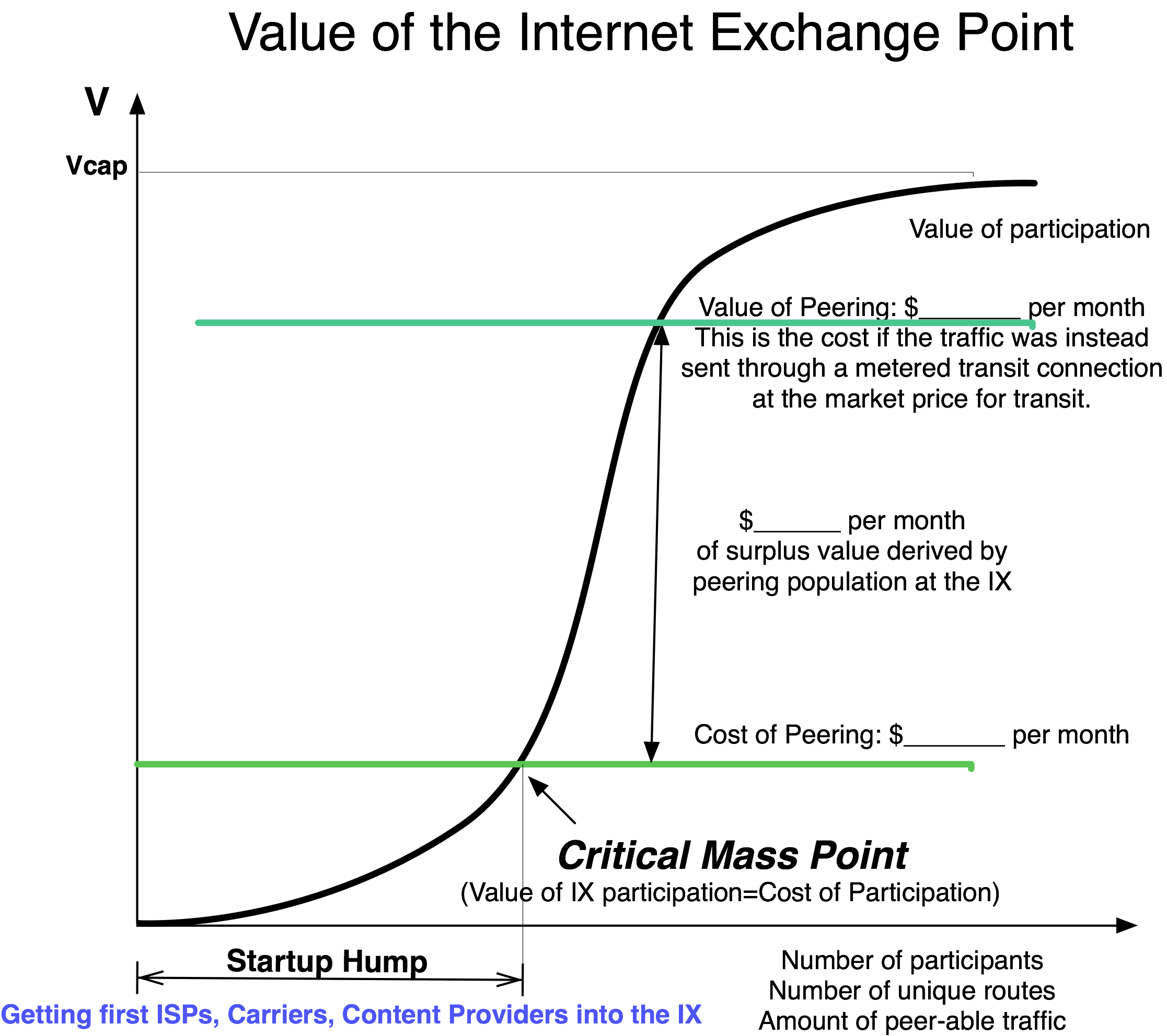
It is also important to track the other parameters of the value equation, including the unique routes available only at this IXP, the marketing position of the IXP, and the other derivative values derived from participation at the IXP.
Peering Workshop Practice Questions
Here are a few practice questions from the Internet Peering Workshop:
- An IXP has 20 members exchanging 600Gbps in a market where the price of transit is around $1/Mbps. The cost of peering is $24,000 per year. Is the IXP past critical mass?
- The argument was made that Private Peering has not been counted in the value of the IXP. Why would anyone else care that more traffic is exchanged bilaterally between two peers? Why would this traffic be relevant to the broader peering population there?
- What is the optimal value of a private-peering-only IXP with a homogeneous population of 200 ISPs, each exchanging 100Mbps with every other peer? The price of transit is $2/Mbps. Assume the average cost of building in to the IXP is $5000 per month, and the price of a cross-connect is $300/month.
- Go visit en.wikipedia.org/wiki/List_of_Internet_exchange_points_by_size and determine the value of the top three IXPs (by traffic volume) and the value of the bottom three. What would the price of Internet Transit have to be in order for each of these six IXPs to be at critical mass?
Answers to these questions are in the answer key in the back of the book.