Tactic 21. Overseas Power Play
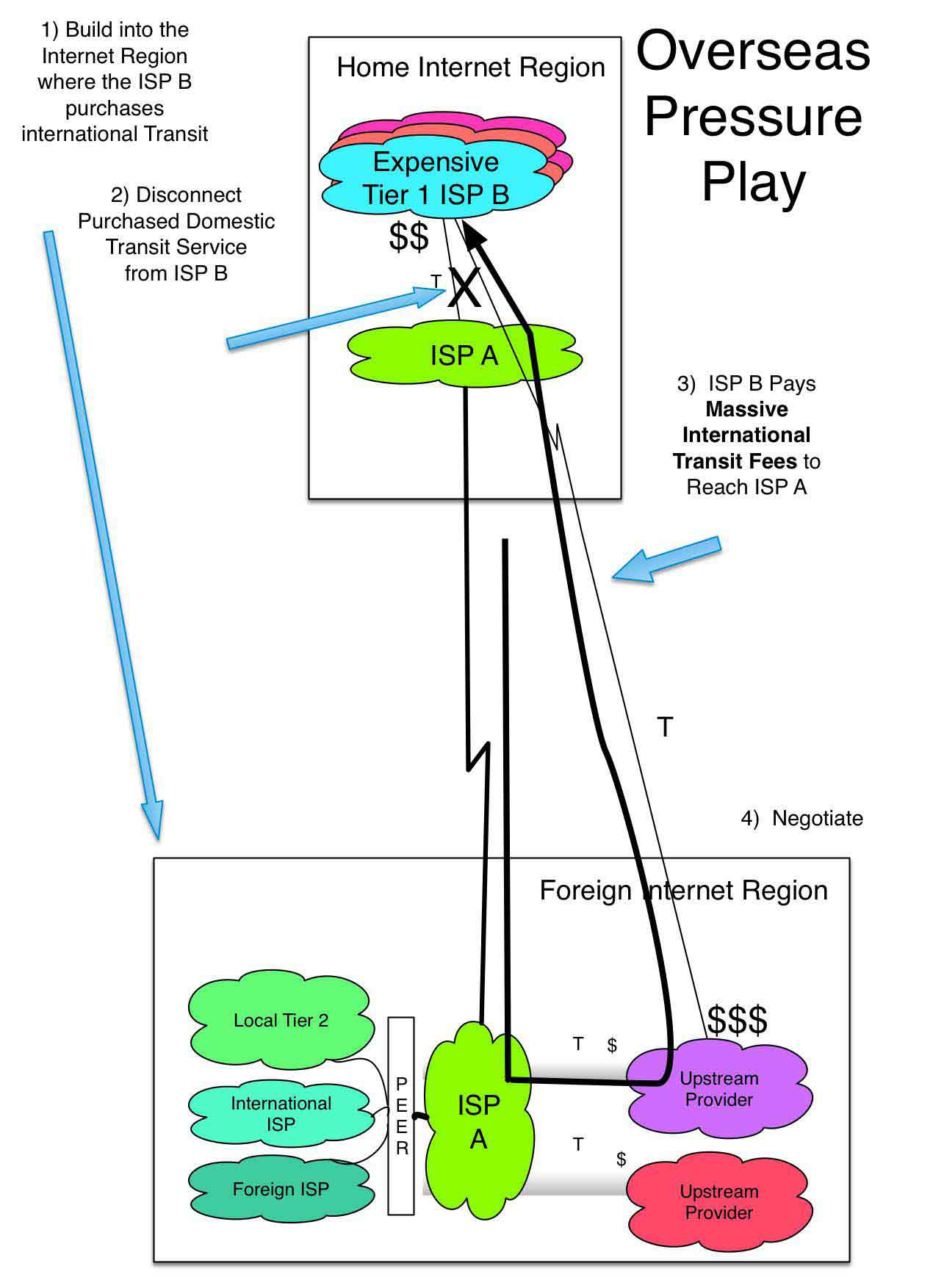
In this maneuver, ISP A wants to pressure the incumbent Tier 1 ISP B to peer by forcing traffic along a more circuitous and expensive international path. The Tier 1 ISP refuses to peer, so ISP A turns off the in-country transit connection, and builds into a well-populated foreign IXP so that it can send its traffic through an international upstream to reach the incumbent Tier 1 ISP.
ISP A has to pay for the international circuit. The incumbent Tier 1 ISP also has to pay for its international circuit into the overseas IXP where it peers. The customers of both ISP A and the Tier 1 incumbent ISP both experience poor performance. The hope is that the Tier 1 ISP will come to the table and say, “We should peer. It is costing us both a lot of money to peer in this other region.”
MWEB played this tactic with Telekom South Africa in 2011:
“We have made a conscious decision that starting next month [November] we will not pay anybody for transit traffic anymore. So if you don’t want to peer with us, that is it! We will not pay you one single cent anymore.”
— MWEB CEO Rudi Jansen
Just like the Traffic Manipulation tactic, this play counts on the pricing and perhaps the performance problems to pressure the target to peer locally to improve performance and decrease its international transit costs. In this example not only will Telekom South Africa customers receive their MWEB video traffic from London at great expense, but the latency-sensitive gaming traffic will also experience really poor performance (Figure 11-36).
Several ISPs have used this tactic to get cheap transit, to force traffic along a circuitous path to pressure the local incumbent to peer, and to decrease the overall cost of traffic by taking care of its own international transit.