The Tier 1 ISP
In each Internet Peering Ecosystem the Tier 1 ISP is at the top of the pyramid.
Definition: ATier 1 ISP is an ISP that has access to the entire Internet Region routing table only through its settlement-free peering relationships.
The term “Tier 1 ISP” has been an overloaded and misused term in the industry. The term has been used to communicate everything from scope (“global”) to quality (“top-notch”).
In this book, however, the term “Tier 1 ISP” has an objective, functional definition, which includes a litmus test that can be used to determine a participant’s position, corresponding motivation, and expected behavior.
The Tier 1 ISP litmus test is whether an ISP pays to reach any destination within a particular Internet Region. If the ISP requires anything more than its free and reciprocal peering arrangements, it is not a Tier 1 ISP in that Internet Region.
So that you may identify this species in the wild, Figure 9-2 shows a model of the Tier 1 ISP.
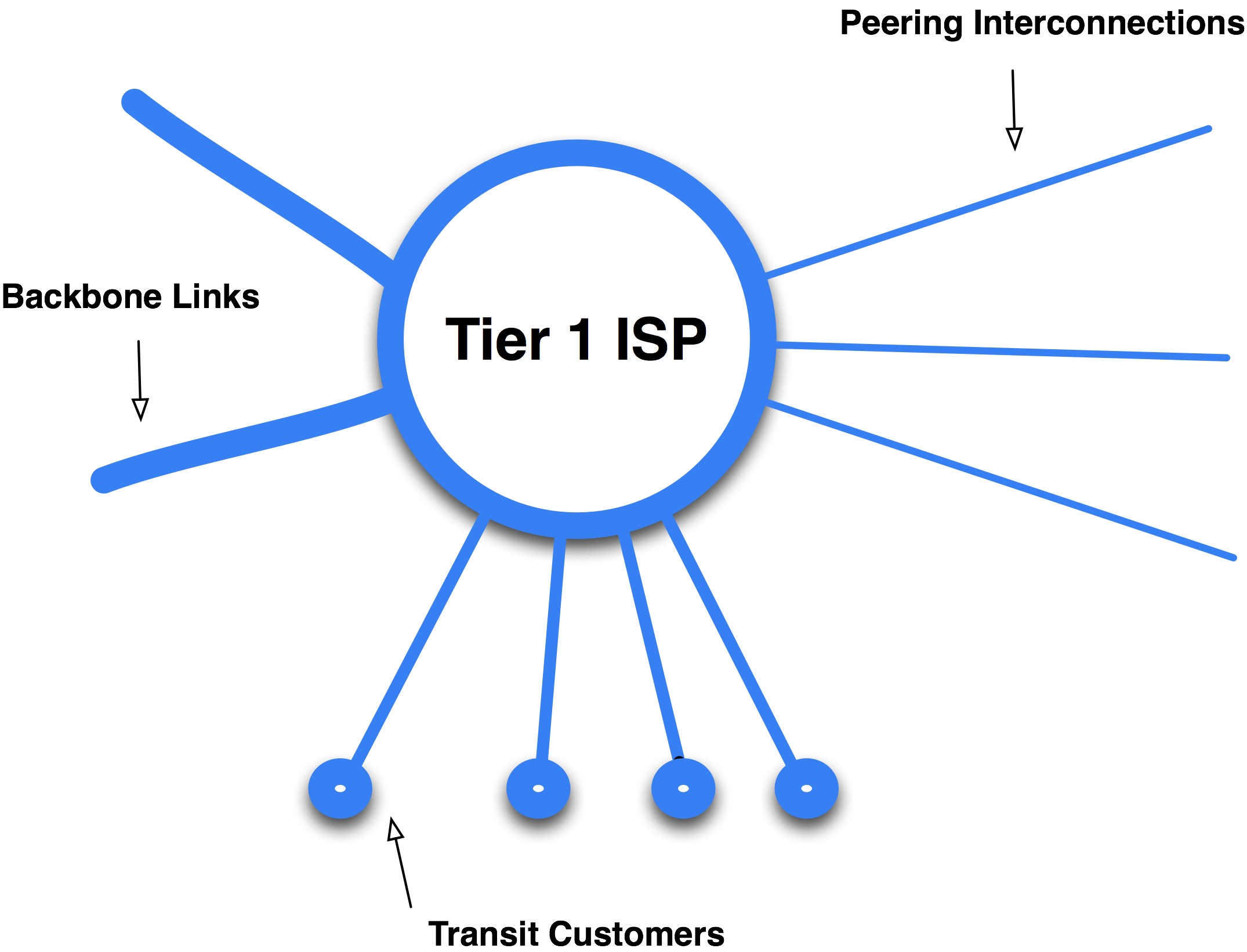
The Tier 1 ISP model has three elements:
- Transit customers links
- Peering interconnections
- Backbone links to the ISP’s other core routers
We will discuss each of these interconnections in turn.
Transit Customer Links. Shown as attached lines underneath the ISP core routers, transit customers connect either directly to the core routers or, more commonly, to tributary routers that feed into the core router.
Peering Interconnections. Each interconnect link needs to have enough capacity to handle the aggregate traffic to and from the other Tier 1 ISPs.
Backbone Links. The lines on the left side of the Tier 1 ISP model represent the backbone connections linking the Tier 1 ISP’s core routers together. The core routers and links together make up the core of the Tier 1 ISP’s transit network. These links must have the capacity to carry the aggregate traffic across the core and on to the end customers.
The Tier 1 ISP Interconnection Mesh
Figure 9-3 shows the full-mesh nature of Tier 1 ISP interconnections. For simplicity, not all Tier 1 ISPs in the U.S. are included in the figure.
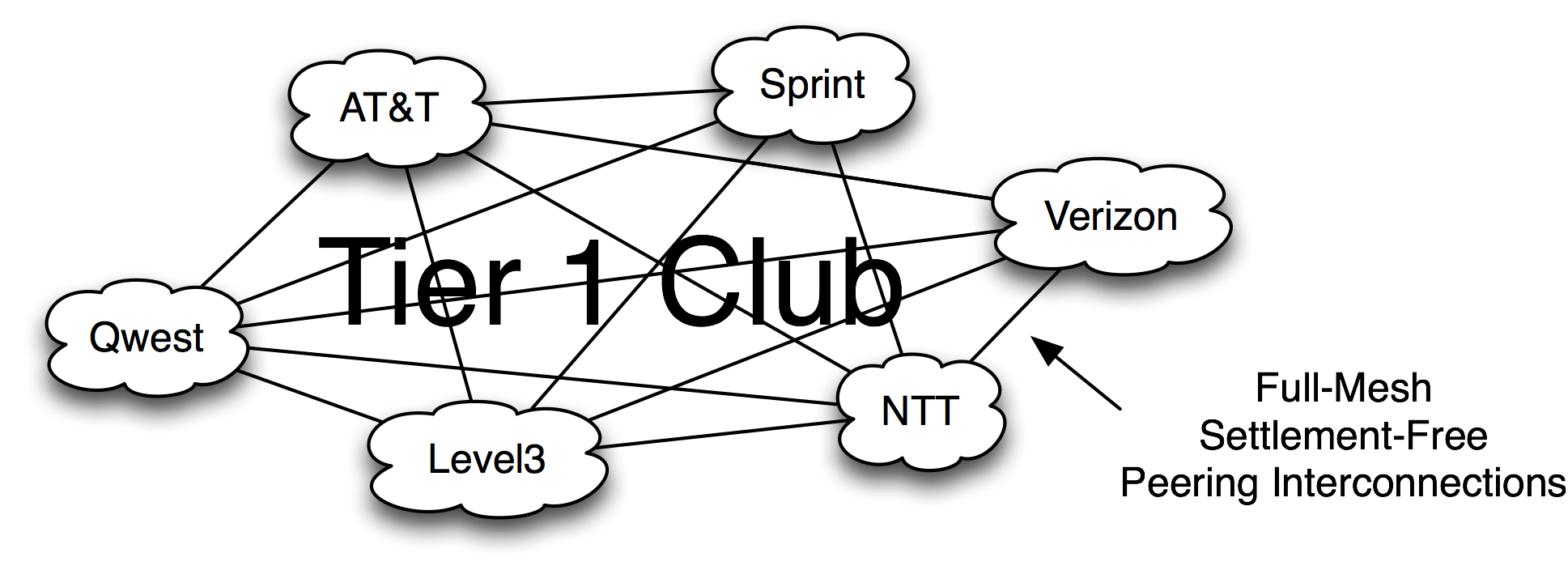
By definition, Tier 1 ISPs enjoy settlement-free access to all destinations within the Internet Region. Some in the peering community refer to the set of Tier 1 ISPs as the “Tier 1 Club.” This area of the Internet Region is called the “default-free zone” since the Tier 1 ISPs do not have a default route to any of the other Tier 1 ISPs for any destination within the Internet Region. They merely announce their customer routes to each other and they have access to the entire Internet Region routing table.
There are few (1–15) Tier 1 ISPs within an Internet Region and, with so few peers, they tend to prefer Private Peering.
The Tier 1 ISPs sell wholesale transit services primarily to resellers, but may also sell directly to the largest content companies.
Tier 1 ISP Interconnect Regions
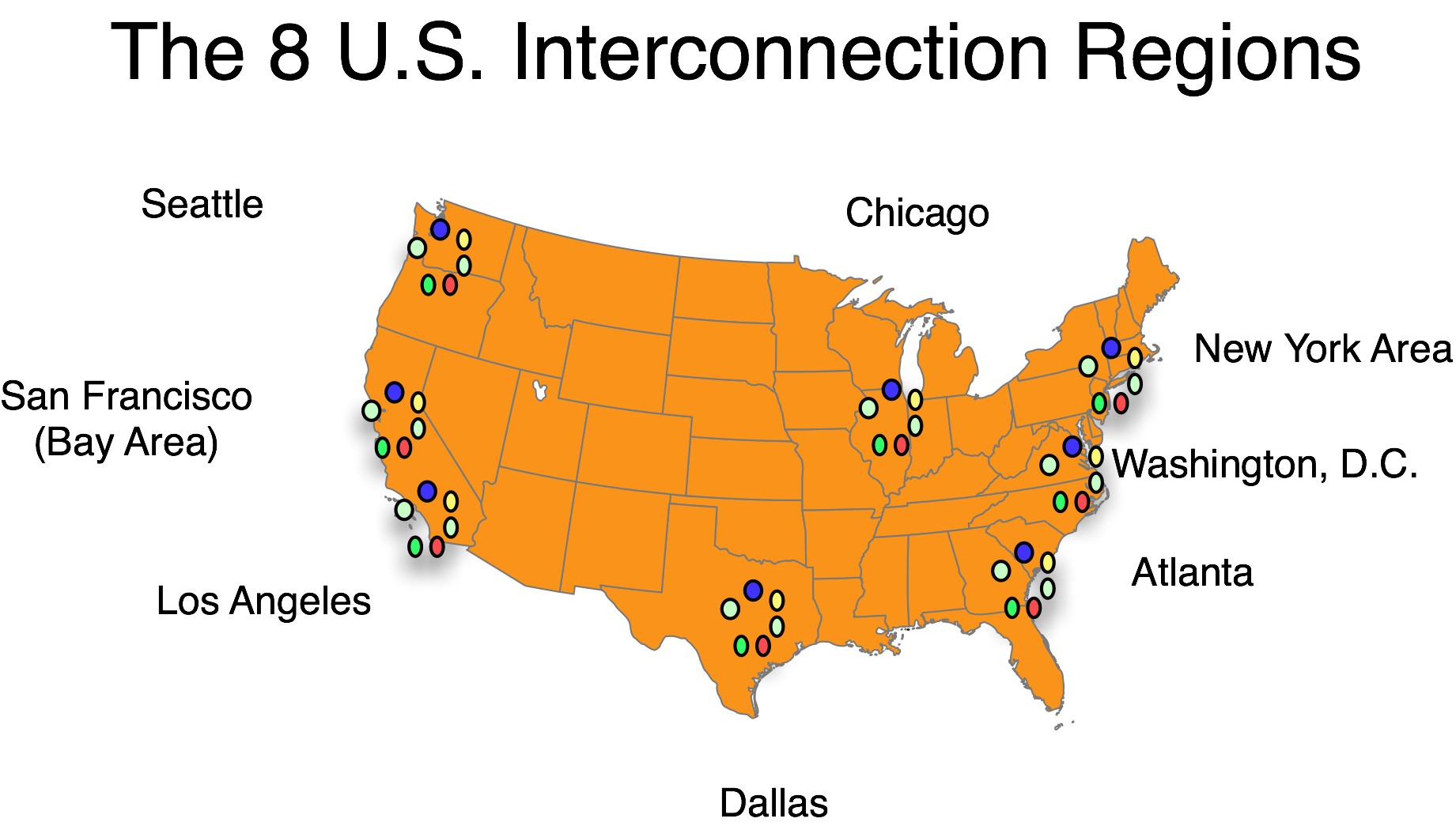
The Tier 1 ISPs in large Internet Regions full-mesh peer with each other in multiple geographically diverse locations. In the U.S. for example, there are eight Interconnect Regions, as shown in Figure 9-4.
There are several reasons for spreading the load like this. First, no single interconnect can handle all traffic between the Tier 1 ISPs. Second, customers look at network maps during purchasing, and they want to see redundancy and resilience. Third, spreading the traffic provides a lower-latency path between the ISPs’ customers. Finally, spreading the load can decrease the likelihood of network congestion and retransmissions, which further overload an already congested network. Spreading the load not only decreases the bit-miles the network has to carry the traffic, it also improves the performance of the network.
Most Internet Regions distribute enough traffic to require multiple interconnect regions.
To understand the behavior of the Tier 1 ISP in the peering ecosystem, we must first take a diversion to talk about Peering Inclinations and peering policies.
Peering Inclinations and Peering Policies
What are the Tier 1 ISPs’ motivations? To answer this question, we need to separate the Tier 1 ISP Peering Inclination from its articulated Peering Policy.
Definition: A Peering Inclination is a predisposition towards or against peering in a particular Internet Peering Ecosystem.
Definition: A Peering Policy is an articulation of the Peering Inclination; it documents and defines (for others) the prerequisites to peering.
The Peering Policy is what one might find on an ISP web site, or it may be received after signing a nondisclosure agreement. But to predict the peering behavior, it is important to understand the underlying Peering Inclination.
There are roughly four categories of Peering Inclination observed in the field, as shown in Figure 9-5.

An “Open” Peering Inclination is a willingness to peer with any other player in the ecosystem.
A “Selective” Peering Inclination is the willingness to peer with any other player, but with a few requirements. A common requirement is that there must be a minimum traffic volume for peering to be worth setting up.
A “Restrictive” Peering Inclination reflects a desire not to peer with anyone other than their existing peers.
A “No Peering” Peering Inclination reflects the desire not to peer at all. Purchasing transit is the preferred method for these players.
Peering Position and Peering Inclination Predict Behavior
We can predict peering behavior by identifying the player position and its corresponding Peering Inclination.
One might ask “Why model both a Peering Inclination and a Peering Policy? Aren’t they the same?”
Consider this common (composite) story heard in the field.
Stated most eloquently by Waqar Khan (Qwest, a Tier 1 ISP in the U.S.),
“We have all the peering we need.”
And he is correct. Almost all Tier 1 ISPs across the globe we studied exhibited the same motivations and exhibit the same behavior – they simply do not need, nor do they want, any more peering. In the field they call it a Restrictive Peering Policy, but everyone knows that means that they are not interested in peering with anyone else in their Internet Region.
Definition: A Restrictive Peering Policy is an articulation of an inclination not to peer with any more entities.
Few Tier 1 ISPs will publicly admit that they have a Restrictive Peering Policy. They will argue that they have a Selective Peering Policy by these definitions because the requirements are objective and articulated, and they would claim that some have found the requirements reachable.
As demonstrated in the notes from the field, most peering policies can be updated at any time. The threat of regulation has made the Tier 1 ISPs systematically keep track of peering requests and the processing of those requests through their systems. They want to be able to demonstrate how they are consistent about the application of their publicly stated policies. Ultimately however, the decision to peer is an internal business decision. The important thing to understand is the underlying motivations. That will ultimately drive behavior, regardless of what the Peering Policy indicates.
Tier 1 ISPs see the rest of the participants in the Internet Peering Ecosystem as potential customers, and do not seek peering with them. In fact, they are averse to peering – they have all the peering that they need, and perceive additional peering as a loss of paid transit revenue.
To summarize, Tier 1 ISPs generally have a Restrictive Peering Inclination, which can be articulated clearly as a Restrictive Peering Policy, or sometimes less clearly as a “Selective Peering Policy.” Since they already have by definition free access to every destination within the entire Internet Region, and they forego revenue by peering, there is no incentive to accept additional peers.
In every Internet Region around the world, Tier 1 ISPs do not want to peer with anybody else. But there is always an exception to the rule, and I found it in Italy.