Tactic 3 - Multi-Homing
Most companies and ISPs start off singly homed. They pay the metered rate and they get access to the Internet and it just works – until it doesn’t.
Multi-homing is the practice of connecting to two or more upstream ISPs. Most large-scale companies spread their traffic across two or more ISPs in order to improve performance and resiliency and reduce costs in a competitive market (see Figure 3-3).
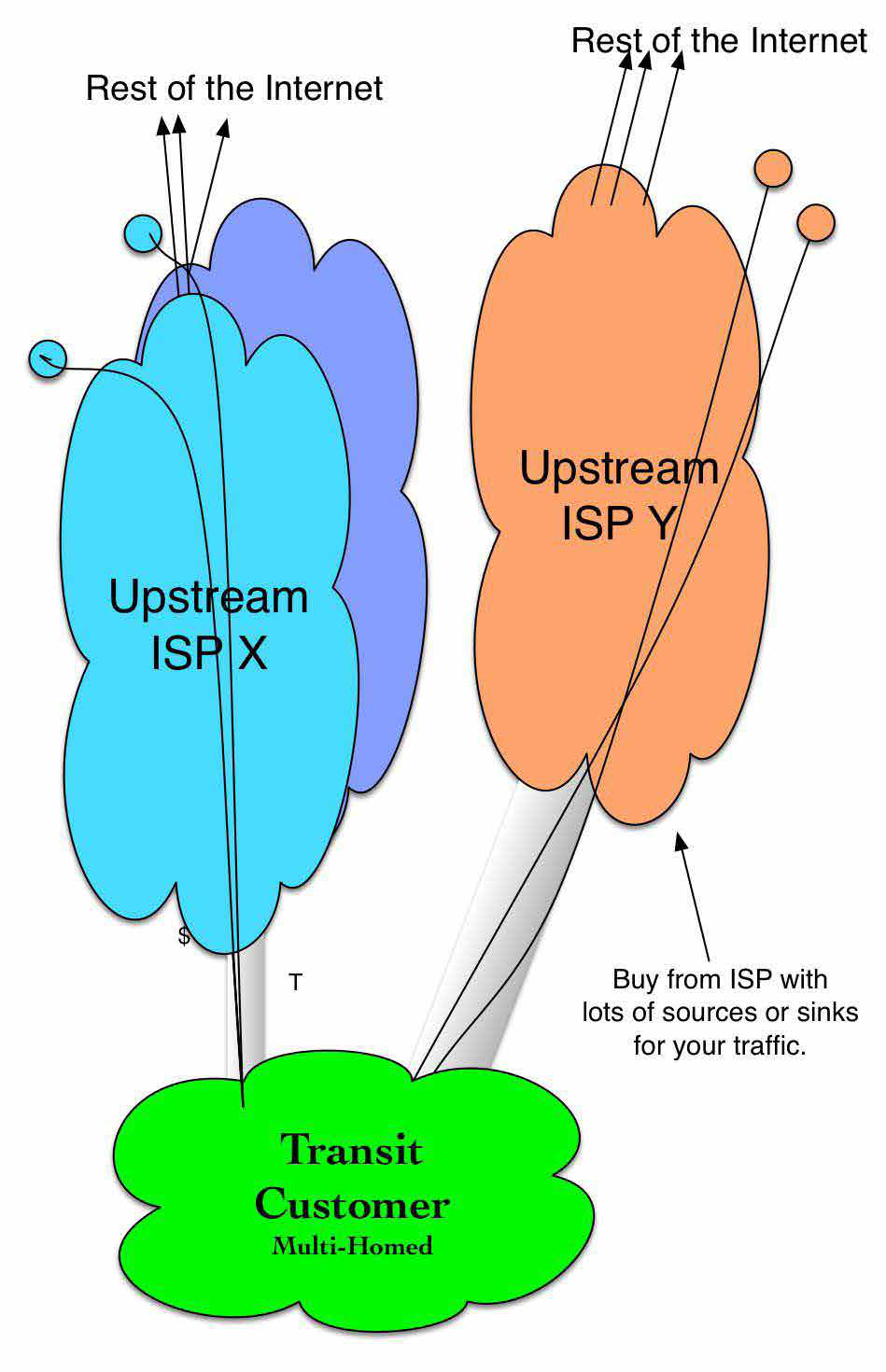
But there are some hurdles they need to overcome.
Many of these companies don’t have the internal networking resources to explore multi-homing. While not difficult, it may be challenging for a systems administrator to learn enough about networking to configure multi-homing the first time.
One flavor of this multi-homing tactic is to build into a well-populated co-location center – a data center housing an open market for Internet Transit services. You will pay for the cost of getting there, but the open-market effect may result in transit pricing 30% or more lower than if the transit provider has to build into your location.
One final benefit of multi-homing is that it makes the path to free traffic exchange (“peering”) much easier. The trick here is to identify the appropriate co-location center for transit and future peering, and the appropriate upstream ISPs for multi-homing. We will discuss this in a later chapter.